
Electrical panel replacement and service upgrades
Replacing a worn-out or problem panel, increasing service for new equipment, or both. This page explains the differences in plain terms so you can compare estimates with confidence. It covers homes in Puyallup, South Hill and Bonney Lake.
Short answer
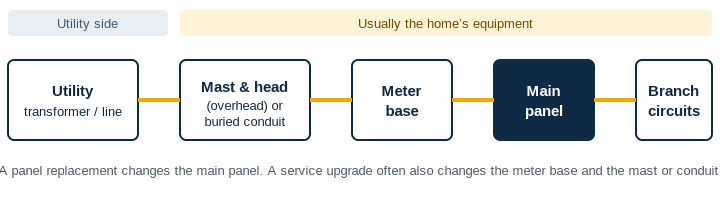
A panel replacement swaps the breaker panel and keeps the same service size. A service upgrade increases the amps your home can draw from the utility, for example from 100 to 200 amps. It usually involves the meter base and service wiring, and it always involves the utility. Many projects are one or the other. Some are both.
Panel replacement vs. service upgrade vs. subpanel
| Option | What changes | Adds capacity? | Typical reasons |
|---|---|---|---|
| Panel replacement | The panel (enclosure, bus and breakers). Service size stays the same. | No | Damaged or problem panel, legacy brand, no usable breaker spaces |
| Service upgrade | Service size, usually with a new panel, meter base and service conductors. Sometimes the mast or underground run too. | Yes | A load calculation shows the existing service can’t support current or planned equipment |
| Subpanel | A second panel fed from the main panel | No. It adds spaces, not amps. | More circuits in a garage, shop or addition when capacity is already adequate |
Do you really need to replace your panel?
Not always. Replacement is worth considering when one or more of these applies:
- The panel shows warning signs such as heat, scorching, corrosion or breakers that won’t stay reset.
- It’s a brand with documented failures in CPSC testing, such as Federal Pacific (Stab-Lok), or one home inspectors commonly flag, such as Zinsco.
- It’s a fuse box being asked to power a modern household.
- There are no usable spaces left for circuits you need.
- A load calculation shows the service can’t support equipment you’re adding.
If the panel is in good condition, has room and has enough capacity for your plans, replacement may not be necessary. An honest evaluation should tell you that.
Do you really need 200 amps?
Only if the numbers say so. 200 amps is a common size for a new service, but it isn’t required for every home. The deciding tool is a load calculation under the National Electrical Code (NEC). It compares your home’s existing load plus anything you plan to add against the service rating. For existing homes, the NEC also allows the calculation to use the home’s actual measured peak demand.
Can you keep 100-amp service?
Often, yes. If a load calculation shows your current and planned loads fit within 100 amps, there may be no reason to upgrade. When they don’t fit, the options include a service upgrade, choosing smaller or lower-setting equipment, or load-management devices that limit when big loads run together. Which one makes sense depends on the calculation and your plans.
EV chargers, heat pumps, generators and solar
Each of these may require a panel or service upgrade, subject to a proper NEC load calculation. None of them requires one automatically.
- EV charger: a Level 2 charger is a large continuous load. Whether your service can take it depends on your existing load and the charger’s setting. Many chargers can be set to a lower current.
- Heat pump: the equipment size and any backup electric heat strips drive the load. Replacing electric baseboard or a furnace changes the calculation in different ways.
- Generator: connecting one to your home’s wiring involves a transfer switch or an approved interlock, so panel space and compatibility matter as much as capacity.
- Solar or battery: the panel’s bus rating limits how much solar can connect to it. Utility interconnection rules apply, so some systems need a panel change and others don’t.
Planning more than one of these? Mention all of them when you request an estimate so the calculation covers everything at once.
Can you replace the panel without replacing the service?
Yes, when the existing service size is adequate and the meter base and service conductors are in acceptable condition. That keeps the utility side simple. If the service equipment is damaged, undersized for your plans or doesn’t meet current requirements, it may need to change too.
Can you add a subpanel instead?
A subpanel solves a space problem, not a capacity problem. It gives you more breaker positions, but everything on it still draws from the same service. If your main panel is full but the load calculation shows spare capacity, a subpanel can be a sensible, lower-cost option. If capacity is the issue, or the main panel itself is a problem brand or in poor condition, a subpanel doesn’t fix it.
What a panel or service upgrade usually includes
Scope varies, which is why the details matter more than the headline price. A complete estimate should say whether each of these is included:
- The new panel, main breaker and the breakers needed to reconnect existing circuits
- Meter base, the socket the utility meter plugs into. It is rated for a maximum amperage and is often replaced during a service upgrade.
- Mast and weatherhead (overhead service): the pipe and cap where the utility’s lines attach. They may need repair, replacement or height corrections.
- Underground service: conduit and conductors from the utility’s equipment. Upsizing can mean trenching and surface restoration, which is why it usually costs more than overhead work.
- Grounding and bonding corrections
- Circuit protection required when circuits are modified, and surge protection if included
- Permit, inspection and utility coordination
- Patching of drywall or siding, if needed
Permits, inspection and utility coordination
Do you need a permit? Yes. Washington requires an electrical permit and inspection for electrical work, with limited exceptions, and panel and service work needs them.
Who pulls it? Washington L&I says that if you hire an electrical contractor, the contractor must buy the permit for the work they do. Homeowners should only buy a permit for work they do themselves on their own property, and L&I strongly encourages hiring an electrical contractor for all electrical work.
Who issues it and inspects the work? For addresses in Puyallup, Bonney Lake, Sumner and Edgewood, it’s Washington L&I. None of those cities runs its own electrical permit program. Electrical permits in South Hill are handled by Washington State L&I in most cases. If your home is served by Tacoma Power, the permit may instead go through Tacoma Power. A licensed electrician will confirm which authority applies to your address. L&I inspects work to the 2023 National Electrical Code.
What is utility coordination? The power has to be disconnected at the utility side for a panel or service change and reconnected afterward. L&I directs that the serving utility be contacted for any work that needs a disconnect and reconnect. Its requirements must be met. Your estimate should say who arranges it.
Sources: Washington L&I, Electrical Permits, Fees & Inspections and City Electrical Permits & Inspections.
How long will the power be off?
The power is off from the utility disconnect until reconnection. How long that takes depends on the scope. A like-for-like panel swap is simpler than a service upgrade with a new meter base or an underground run. It also depends on utility scheduling and the inspection sequence. Ask for the expected outage window in writing with your estimate, and plan for refrigerators, medical devices and work-from-home needs.
Why two quotes can be very different
Big gaps between estimates are usually about scope, not just price. One quote may be for a panel swap and the other for a full service upgrade. One may include the meter base, grounding corrections, surge protection, permit and patching while the other leaves them out or treats them as extras. Compare these line by line:
- Same service size (amps)? Same panel size and number of spaces?
- Meter base, mast/weatherhead or underground work included?
- Permit, inspection and utility coordination included, and who handles them?
- Grounding and bonding, required circuit protection, surge protection?
- Drywall or siding patching?
- How problems found after opening the panel are handled and priced
- Warranty terms, in writing
We don’t publish prices because they depend on these details. A useful estimate is based on your actual panel and service equipment.
Hidden conditions that can change the scope
- Corroded or heat-damaged conductors found when the panel is opened
- Undersized or damaged service conductors, or a deteriorated meter base or mast
- Missing or inadequate grounding and bonding
- A panel location that no longer meets clearance requirements and has to move
- Older branch wiring that needs attention where it connects to the new panel
- Utility requirements for the service entrance or metering
A good estimate says how these are handled if they turn up, before work starts.
Get an estimate for your panel
Tell us your current panel, service size if you know it, and what you’re planning to add. See what to have ready.